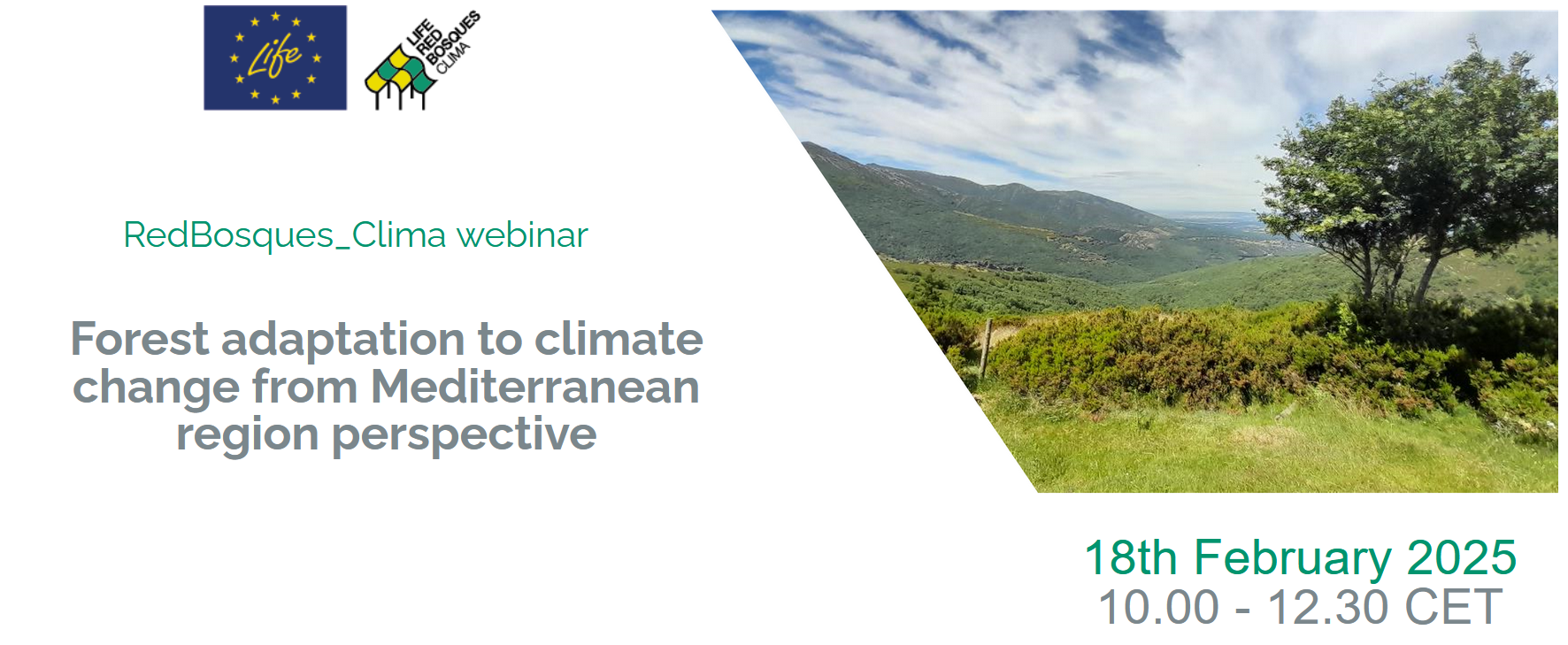
In the European context, forests in the Mediterranean region exhibit unique characteristics. Beyond differences in species composition due to biogeography, Mediterranean forests hold great ecological value, though they have lower primary productivity and are highly exposed to disturbances such as wildfires. In low intensities and frequencies, these fires are considered an integral part of natural dynamics.

The socioeconomic environment, partly shaped by this low productivity, also presents particularities, such as a less developed forestry sector and the abandonment of traditional wood and firewood harvesting. This has resulted in an increase in forest area and accumulated biomass, which, in turn, amplifies risks associated with climate change.

EU forest restoration policies emphasize planting new trees, often sidelining the management of existing forest stands and improving their heterogeneity and diversity—an alternative that, from an adaptation perspective, would be more suitable for the Mediterranean context.

This webinar aims to showcase the challenges faced in the management and conservation of forests within the current climate change scenario, with specific attention to Southern Europe.

Program

  • 10.00 – 10.15 Introduction to LIFE RedBosques_Clima project. José Atauri, Fundación Fernando González Bernáldez.

  • 10.15 – 10.45 Priorities in adaptation to climate change in Spanish forests. Guillermo Fernández Centeno, Spanish Ministry for Ecological Transition.

  • 10.45 – 11.15 LIFE Resland: Climate change adaptation for forests in a Mediterranean context. Jõao Melo, Cascais Ambiente. Cascais City Council (Portugal).

  • 11.15 – 11.45 Forest management in Mediterranean Europe: Key challenges identified in LIFE GoProForMed. Serena Corezzola, D.R.E.AM. Italia.

  • 11.45 – 12.30 Discussion with participants. Moderator: Diego García, Fundación Fernando González Bernáldez

Speakers

  • José Antonio Atauri, PhD in Ecology. He has developed his professional career as a researcher in landscape ecology, and since 2005 in EUROPARC-Spain. He is currently coordinating the LIFE RedBosques_Clima project.

  • Guillermo Fernández Centeno is currently Technical Advisor of the General Subdirectorate for Forestry Policy and Combating Desertification of the Spanish Ministry for Ecological Transition. He holds a degree in Forestry Engineering (Universidad Politécnica de Madrid) and has worked in this Subdirectorate for the last 18 years in various positions of responsibility related to forestry information, forestry and forest management planning.

  • Jõao Melo, Landscape Architecture graduate from the University of Évora. Postgraduate diploma in Executive Management from the AESE Business School. He started his professional career in the private sector, designing landscaping projects. He is now Director of the Municipal Ecological Structure in Cascais municipality. He is in charge of the municipality’s natural conservation areas and Natura 2000 network, with a particular emphasis on ecological restoration, rural fires, nature tourism, and rewilding. Member of the Europarc Federation, currently in the Federation Council and chairing the Sustainable Agriculture Commission in protected areas.

  • Serena Corezzola, an Italian natural scientist, works at D.R.E.AM Italia in the Coordination Team for forest-related LIFE Projects, including LIFE GoProFor and LIFE GoProForMED. Since 2018, she has focused on integrating forest management and biodiversity conservation, building on her prior experience monitoring forest biodiversity at the National Center for the Study and Conservation of Forest Biodiversity in Mantua.

Outcomes

José Antonio Atauri

DOWNLOAD

Guillermo Fernández Centeno

DOWNLOAD

Jöao Melo

DOWNLOAD

Serena Corezzola

DOWNLOAD