

Forest diversity restoration for climate change adaptation
The MUP 276 is located in Sierra Norte de Guadalajara Nature Park, covering 2,583 hectares, and it is owned by the autonomous community. It exhibits a clear state of decline and stagnation in tree growth (both Pinus sylvestris and Quercus pyrenaica), with a low level of regeneration. Since its reforestation in 1972, forest management has been practically absent, and it has suffered two wildfires in the 1990s.
The objective of the action is to improve resilience to climate change by promoting the mixed character of forest habitats (oak groves, beech forests, and birch forests), and the mosaic with Mediterranean high mountain grasslands and shrublands.
Within the “Cuartel del Monte” area, two action zones have been delimited: a reforestation of Pinus uncinata on a grassland habitat of community interest (Canton 16) and a very dense reforestation on Pinus sylvestris terraces (Canton 29).
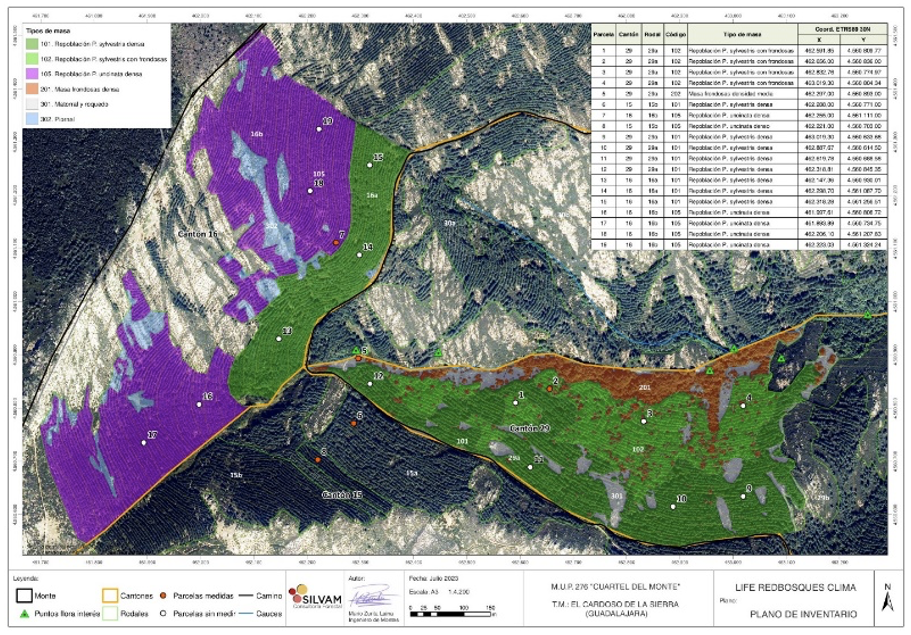
Delimitation of the action zones in action C5.
Participatory process
The Regional Government of Castile-La Mancha acts as the promoter of the actions and is also the owner of the forest and manager of the natural area.
The actions indirectly affect various stakeholders in the territory (local authorities, livestock farmers, hunters, beekeepers, hikers, companies responsible for carrying out the work, wood and biomass industries, and civil society in general). For this reason, information sessions have been held with the various stakeholders involved in the project, and the project has been reported on through the park’s governing board and trustees.
Vulnerability assessment
Within the Cuartel del Monte forest, two areas of action have been defined: a very dense reforestation of Pinus sylvestrison terraces (Cantón 29) and a reforestation of Pinus uncinata on a habitat of scrubland and grassland of Community interest (Cantón 16).
Pine forests of Pinus sylvestris
The drought risk assessment was carried out using the method developed in the project.
The Pinus sylvestris pine forests in the action area present a drought risk above the average value in Spain. Exposure, understood as the ecological conditions specific to the geographical location of the forest and the climatic characteristics of the area, is below the national average. This is because the area of action, located on north-facing slopes at an altitude of between 1,500 and 1,900 m and with average rainfall of over 1,000 mm per year, has climatic and environmental conditions that are suitable for the species.
On the other hand, vulnerability as a result of the composition, structure and characteristics of the forest species is above average for this type of pine forest. Vulnerability is very high as a result of the high density, regularity, reduced degree of development and low functional diversity of species in the areas targeted for action.
Piornales, heaths and oromediterranean grasslands
Their uniqueness stems from being the only representation of Oromediterranean habitats in Castilla-La Mancha and the best regional representation of Eurosiberian relict habitats: the peaks of the Sierra de Ayllón are located in the Oro and Crioromediterranean bioclimatic zones, presenting communities characteristic of these high altitudes, which are very rich in endemic species.
Mediterranean high mountain grasslands and associated broom thickets and grasslands are among the habitats most vulnerable to climate change in this mountain range, due to the reduction in snowfall and the length of the snow season. These habitats are also particularly sensitive to non-climatic stress factors, such as the abandonment of traditional extensive livestock farming and the occupation of the habitat for other uses, in this case forest plantations.
Objectives
The overall objective is to improve the forest’s resilience to climate change by promoting mixed forest habitats (oak, beech, and birch forests) and a mosaic of grasslands and Mediterranean high-mountain scrubland. To this end, two specific objectives have been set:
- Climate change adaptation measures in reforested Scots pine (Pinus sylvestris) forests:
Reduce density, reduce regularity, improve the pine forest’s vegetation state, and increase the diversity of canopy species by removing competition and promoting the development of deciduous species that appear interspersed within it.
- Habitat restoration actions in reforested Scots pine (Pinus uncinata) forests:
Restore the habitats of the mountain ecotone. Encourage the colonisation of summit areas by potential habitats of oromediterranean broom scrub (HIC 5120), cervunales (HIC 6230) and cryomediterranean psicroxerophilous silicicolous grasslands (HIC 6160).
Implemented actions
Silviculture is established as a tool for achieving adaptation objectives through pine forest cutting at different intensities, clearing and opening up glades to initiate the recovery of certain processes that have been halted by spatial competition and lack of light. This will increase the proportion of accompanying species, including Quercus pyrenaica, Quercus petraea, Fagus sylvatica, Betula pubescens, Sorbus aria, Sorbus aucuparia and Frangula alnus, currently dominated by the pine forest.
The work was carried out mechanically using a forestry processor and a self-loading truck. In general, one terrace in four was used as a working aisle, from which the upper terrace and the two lower terraces, accessible to the processor head, were worked on.
Chainsaw operators supported the work by felling the furthest trunks towards the area where the machinery was operating, which then proceeded to delimb and cut them.
Table 1. Summary of the actions carried out in the three sections of the forest
| 101. High-density of P. sylvestris reforestations | 102. High-density of P. sylvestris | 103.Reforestation of P. sylvestris with broadleaves | |
| Intensity of cuts | 52% | 51% | 55% |
| Density of cuts | 870 trees/ha
70 m3/ha |
465 trees/ha
50 m3/ha |
330 trees/ha
55 m3/ha |
| Density objective | 800 trees/ha | 450 trees/ha | 270 trees/ha |
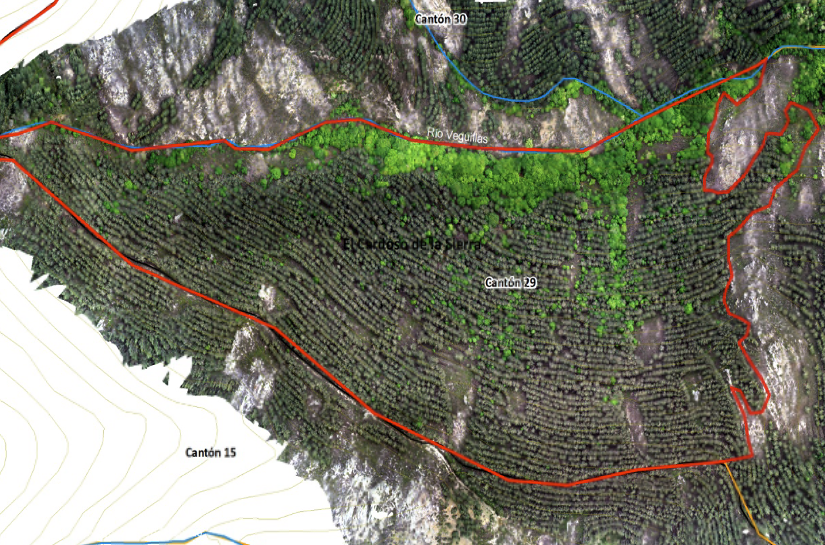
High-resolution orthomosaic of the area of intervention. The terraces repopulated with Pinus sylvestris and the broadleaves to be released are visible.
Oromediterranean pine groves, heaths and grasslands.
For the grasslands, the proposed measures focus on eliminating non-climatic pressures, in this case the repopulation of Pinus uncinata on its potential habitat.
The intervention has consisted of the elimination or drastic reduction of the pine forest, by means of clear felling or very heavy thinning. The total intervention area covers a surface of 18.42 ha, but silvicultural work was only carried out on 16.06 ha, as the remainder corresponds to non-wooded areas.
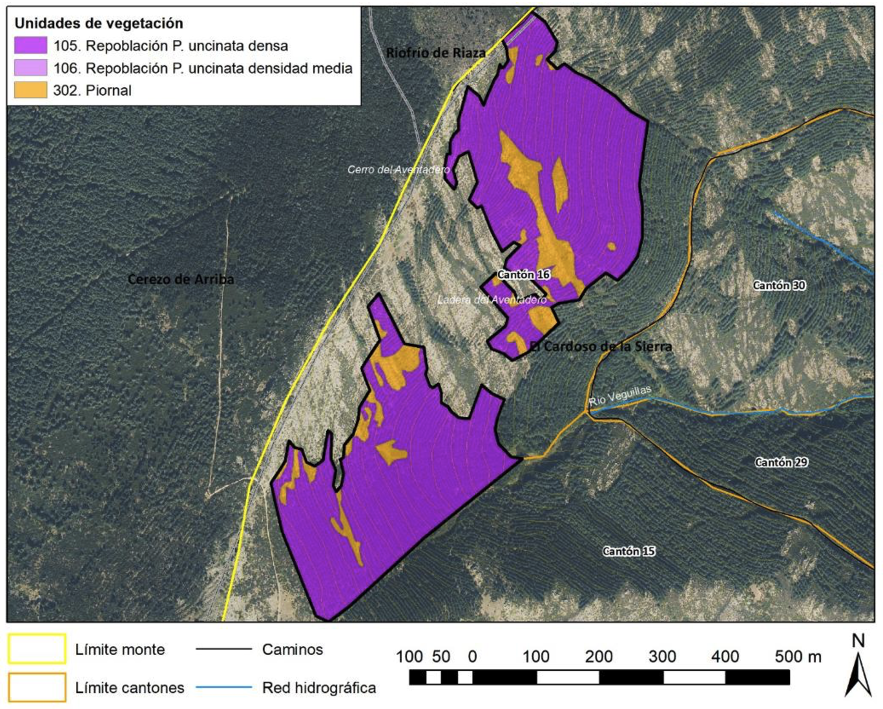
Areas of intervention in Pinus nigra reforestations.


