

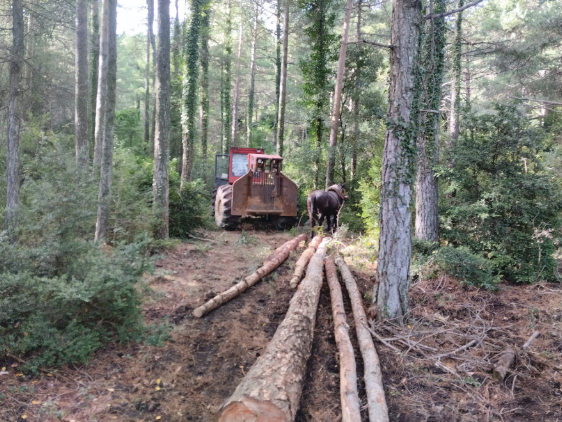
The current structure of the forests in the Els Ports Natural Park is the result of decades of resource exploitation, such as timber, firewood, and pasture, which was suddenly abandoned in the mid-20th century.
The park’s forests consist of natural stands of Pinus nigra and P. sylvestris, and in the warmer areas, Pinus halepensis and Quercus ilex. In general, these are very homogeneous, young forest stands with little diversity. The scarcity of large herbivores (domestic and wild) has favoured the accumulation of biomass and greater homogeneity.
However, in many areas, the forests have gained in maturity and structural complexity, with a growing presence of high-ecological-value elements, such as dead wood, senescent trees, a higher proportion of accompanying tree species, and a more diverse undergrowth.
The aim of this action is to create a landscape that is resilient to climate change. By restoring basic ecological processes, a heterogeneous mosaic will be created, interspersing forest stands in different stages of development with open areas, which as a whole will be less vulnerable to droughts and fires.

Landscape mosaic in Els Ports Nature Park, current state.

Landscape mosaic in Els Ports Nature Park, expected state.
Implemented actions:
1. Informative and participatory process
The action carried out in the Els Ports Nature Park consisted of addressing landscape-scale forest planning in coordination with public and private landowners.
As a first step, a sector of the nature park with its own landscape identity was selected. The forest owners in the area were identified, resulting in a total of 20 estates covering 16,413 ha.
As a result of the participatory process, eight of these estates have been incorporated into the project: two ‘pilot’ estates (on which the LIFE project finances the actions) and six ‘replica’ estates (on which the actions are financed through other funds). The total area of these estates is 4,824 hectares, representing 14% of the Nature Park.
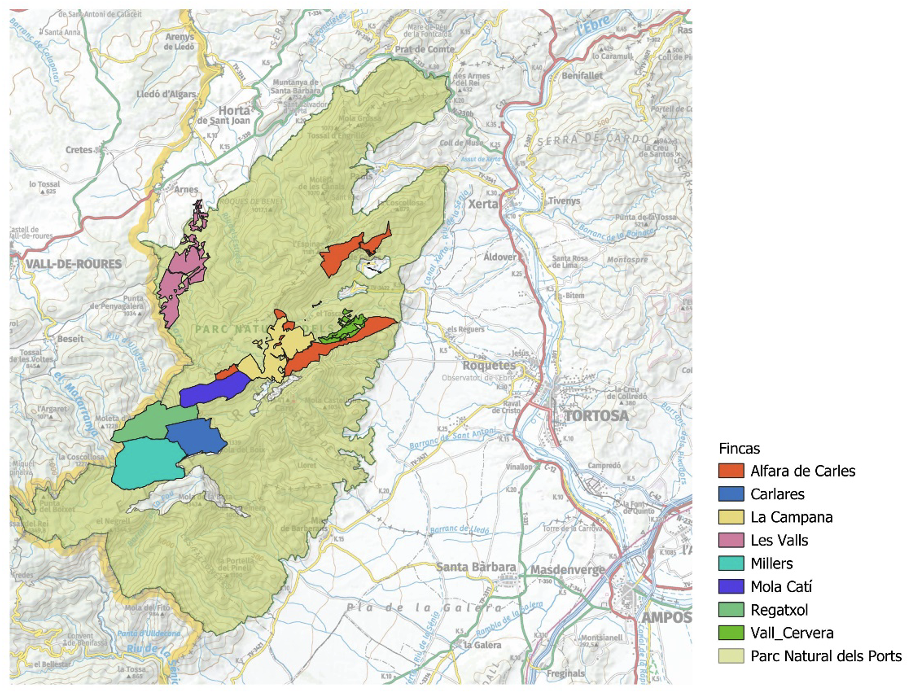
Estates participating in the LIFE RedBosques_Clima project in the Els Ports Nature Park.
2. Development of planning tools
Forest Management Instruments (IOF in castellano) have been drawn up for each of the eight farms participating in the project. The FMIs have been developed in a coordinated manner, providing for common management models, but adapted to the specific characteristics of each farm.
To make the action viable on such a large scale, three complementary tools are planned to be used: silviculture, prescribed burning and the promotion of herbivory. To this end, a forest management plan, a prescribed burning plan, and a herbivore management plan have been prepared for each farm participating in the project.
You can see the participating farms and the management models planned for each one in this viewer.
3. Vulnerability analysis
Two pilot estates were selected to demonstrate some of the types of actions included in the IOF:
- Estate Vall Figuera, publicly owned. Covered by a mixed pine forest of Pinus sylvestris and Pinus nigra.
- Estate Vallcervera, privately owned. Predominantly Pinus halepensis with isolated specimens of Pinus nigra. In some areas, there is also a stand of holm oak (Quercus ilex).
On these estates, the drought risk index showed that the mixed pine forest is the most vulnerable, followed by the Aleppo pine forest and the holm oak forest.
In terms of climate exposure, the holm oak forest is less affected by general climatic conditions, thanks to its better adaptation to dry environments. However, they are more geographically exposed, suggesting that their location could make them vulnerable in specific contexts, such as arid or very steep slopes.
Pine forests, on the other hand, are somewhat more protected in terms of exposure (climatic and geographical), but are more sensitive in terms of vulnerability. Pine forests—especially mixed forests—are affected by excessive basal area, while holm oak forests are vulnerable due to their small normal diameter and few diameter classes. In terms of recovery capacity, the low regeneration rate in Aleppo pine forests is a disadvantage.
4. Objectives
Once the components of vulnerabilities have been identified, two types of intervention were selected from among those proposed in the management instruments. The objectives defined for these actions on the two estates where the intervention took place were:
To promote greater structural complexity and greater maturity and naturalness of the forest stands, emulating small natural disturbances:
- To encourage the maximum development of a group of trees with a promising future in terms of biodiversity, future productivity or post-fire reserves, through thinning/selective felling and clearing.
- To increase the presence and promote the development of minority tree species through thinning, ringing and clearing.
- Promote the existence of large dead trees, both standing and on the ground, through ringing and felling.
Increase landscape heterogeneity by recovering open or semi-open spaces:
- Recovery of open spaces within the forest landscape, taking advantage of old cultivation terraces.
- Diversify the structure of scrubland, facilitating access and use by wild and domestic herbivores.
Improve the composition and structure of herbaceous and shrubby strata of interest to fauna associated with open spaces and the quality of pasture for herbivores.
5. Implemented measures
Restoration or recovery of open spaces
- Identification of future trees and trees to be cut down, presence of elements of interest and clearing areas.
- Intensive clearing of scrub with machinery (brush cutter and shredder) to remove dense woody vegetation and open up the habitat.
- Localised thinning of scattered trees (pines and holm oaks) to promote canopy opening and the development of key shrub species.
- Generation of dead wood through ringing or cutting without felling.
- Olive grove clearing and pruning.
- Clearing and removal of woody debris using mechanical traction (forestry skidder), facilitating the regeneration of herbaceous and shrubby vegetation.
- Extensive grazing with goats and horses as a tool for sustainable vegetation fuel management and maintenance of the open structure.
Close-to-nature forestry and conservation of ecological processes.
- Identification of future trees and trees to be cut, presence of elements of interest and clearing areas.
- Selective thinning with chainsaws on all future trees to reduce competition and promote growth in diameter and crown of selected trees (dominant stratum trees and accompanying species trees).
- Opening of small clearings by felling trees with chainsaws to diversify the canopy structure and promote incipient strata of tree and herbaceous regeneration.
- Clearing of scrub with chainsaws to free the environment around trees of interest and improve accessibility.
- Generation of dead wood through ringing or cutting without felling.
Clearing of undergrowth using a combination of animal traction (horses) and skidders, to minimise the impact on the soil and undergrowth.

Modelling of the different planned actions.
All planned actions and their implementation status can be accessed in this viewer:


